
Most UK homes can have a heat pump. Plenty of homes are not quite ready for one yet. Both of those things are true at the same time, which is why “is my home suitable for a heat pump?” has a useful answer rather than a simple yes or no.
The good news is that suitability comes down to four practical things, not to the age of your house or the type of boiler you happen to have. This is a checklist, not a sales pitch. If you work through it and find your property needs another measure first, that is a genuinely useful thing to know.
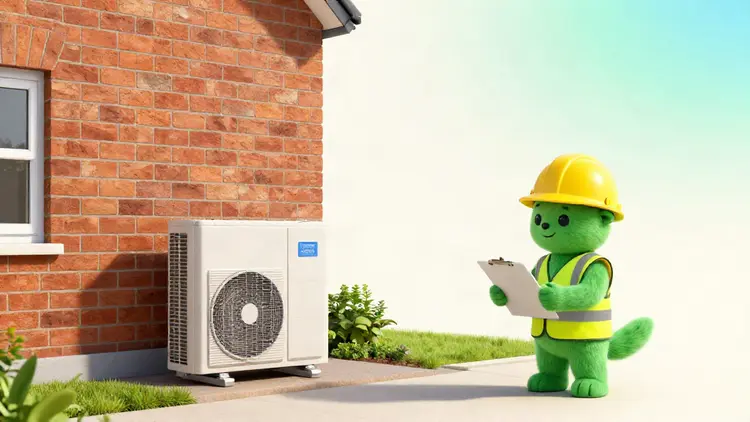
What actually decides heat pump suitability
- How quickly your home loses heat (insulation and draughts)
- Whether your radiators can deliver warmth at a lower temperature
- Whether you have a sensible spot outside for the unit
- How your home is heated today
Everything else is detail on top of those four. Here is what each one means in practice.
1. Insulation and heat loss
A heat pump works best when it runs at a lower flow temperature for longer, rather than firing hard and hot in short bursts. The more heat your home leaks, the harder that steady, gentle approach becomes. So the first question is simply how quickly warmth escapes your property.
Loft insulation, cavity wall insulation, draught-proofing and double or triple glazing all slow that loss down. A home with decent loft and wall insulation often needs nothing else before a heat pump makes sense. A solid-walled period property with single glazing may benefit from some fabric work first. That is not a failure — insulation is usually the cheapest way to make a home feel warmer, and it helps whatever heating system you end up with.
2. Radiators and emitters
A heat pump delivers heat at a lower temperature than a gas boiler. To put the same amount of warmth into a room, you need more surface area. In practice that can mean a few radiators need to be larger, or swapped for ones designed for lower flow temperatures. If you already have underfloor heating in part of the home, that does a lot of the work.
This is not something you have to work out yourself — a surveyor measures each room and sizes it properly. But it is worth knowing before you start that “will I need new radiators?” is a normal question with a normal answer of “sometimes, in some rooms”.
3. Outdoor space
An air source heat pump needs somewhere outside to sit, usually a unit roughly the size of a small bin store. It needs clear airflow around it and a spot that is not directly under a bedroom window or hard against a neighbour's boundary. Ground-mounted units and wall-mounted units are both common.
In most cases, permitted development rights cover a domestic air source heat pump, provided conditions on siting and noise are met. Flats, listed buildings and homes in conservation areas are a different story, so it is worth checking early if any of those apply to you.
4. How your home is heated today
- Gas boiler — the most common starting point, and usually a well-understood swap.
- Oil or LPG — often very good candidates, particularly off the gas grid where running a tank is already a chore.
- Electric storage heaters — a strong candidate, with a clear comfort upgrade.
- A relatively new, efficient boiler in a well-insulated home — a heat pump can still work, but the comparison deserves a careful look rather than an assumption.
- Communal or district heating — a different route entirely, and worth a separate conversation.
When a heat pump is not the right first step
There are honest situations where a heat pump should wait, and it is better to say so.
If your home loses heat quickly and there is no insulation in place, the fabric of the property is usually the sensible first move. If your electrical supply needs an expensive upgrade before a heat pump can run, it can be worth waiting or looking at other measures first. If you are planning to sell the property within a year or two, the numbers rarely stack up for you personally. And if you already have a well-insulated home and a fairly new heating system, it can be worth living with it for another season before switching.
None of these are dead ends. They are just the point at which a different measure might serve you better, at least for now.
What a heat pump survey actually looks at
- Calculate heat loss room by room, rather than sizing on floor area alone
- Check radiator sizes and flag which rooms, if any, would need new emitters
- Identify where the outdoor unit can go, and how it will sound from inside and at the boundary
- Confirm whether there is space for a hot water cylinder
- Look at your consumer unit and electricity supply
- Set out the grant position and any paperwork the installer will handle
You should come out of it knowing what is being proposed for your property and why, not just a price.
One sensible next step
If you want a straight answer on your own home rather than a general one, start with a home-energy review. Someone looks at your property properly, tells you which measure fits it first, and gives you an honest answer if the answer is “not yet”.
That is the whole point of doing it this way. No guaranteed-savings promises, no pressure to sign anything on the day, and where a referral partner pays us, we tell you on the page.
If a heat pump suits your property, the review will say so and match you with a certified installer. If it does not suit your property yet, it will say that too — and tell you what would change the answer.